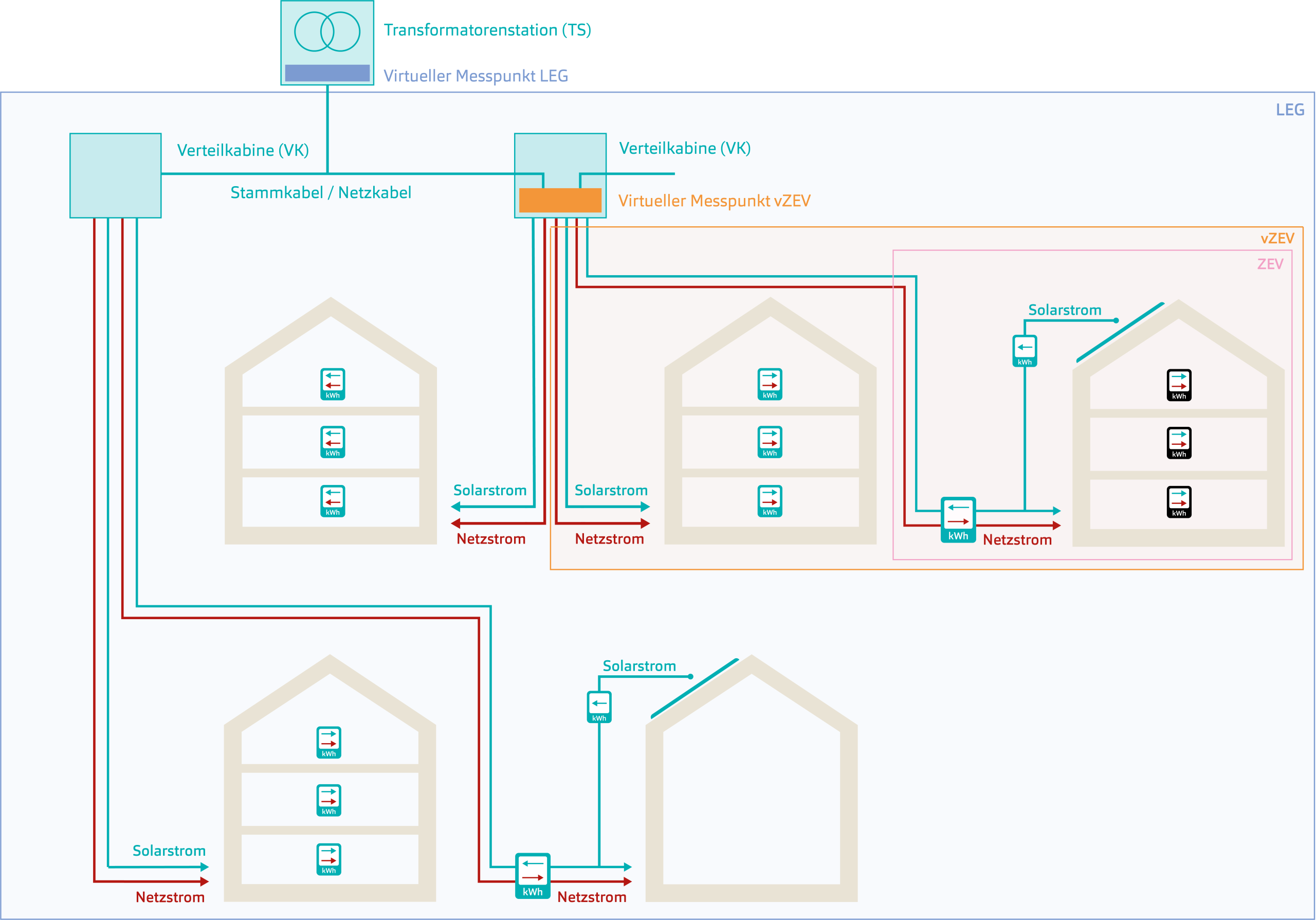
The Federal Government’s Energy Strategy 2050 supports decentralized electricity generation and consumption at the place of production. If several electricity consumers want to use locally generated electricity together, this can be done by joining forces for self-consumption (ZEV). As part of the revision of the law, it will also be possible in the future to use self-consumption across districts with so-called local electricity communities (LEG) and virtual ZEV.
The Federal Government's Energy Strategy 2050 supports decentralized electricity generation and consumption at the place of production. If several electricity consumers want to use locally generated electricity together, this can be done by forming an association for self-consumption (ZEV). As part of the revision of the law, it will also be possible in the future to use self-consumption across districts with so-called local electricity communities (LEG) and virtual ZEV.
IBC is happy to advise you on setting up self-consumption solutions. You can find the setup and service fees here:
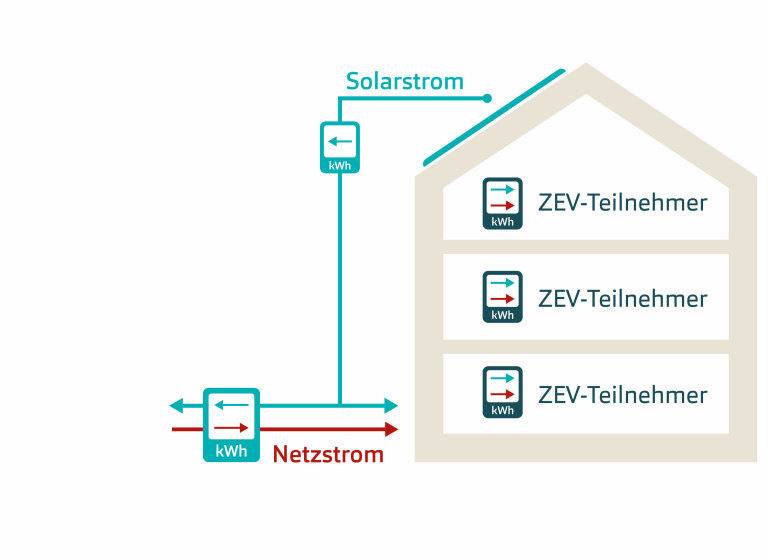
Several electricity consumers can form a joint consumer group and share the electricity produced on-site. Before forming the group, the parties involved (owners, tenants, etc.) must agree on the arrangement. To do so, they form a joint interest group and appoint a ZEV representative. The ZEV representative organizes the billing of energy drawn from the public grid and energy produced on-site among the consumers within the ZEV. Private meters may be used for metering within the ZEV.
Requirements for forming a ZEV:
Multiple property owners join together and appoint a representative who acts as the ZEV’s external representative.
The system’s production capacity must be at least 10% of the ZEV’s grid connection capacity.
The self-generated electricity must be consumed without using the distribution grid.
All ZEV participants are subject to surplus metering. A ZEV is considered a single end customer by the distribution network operator.
An application must be submitted to the local distribution network operator (IBC) at least 3 months before the ZEV begins.
All necessary services can optionally be obtained from the IBC under the ZEV/vZEV billing service.
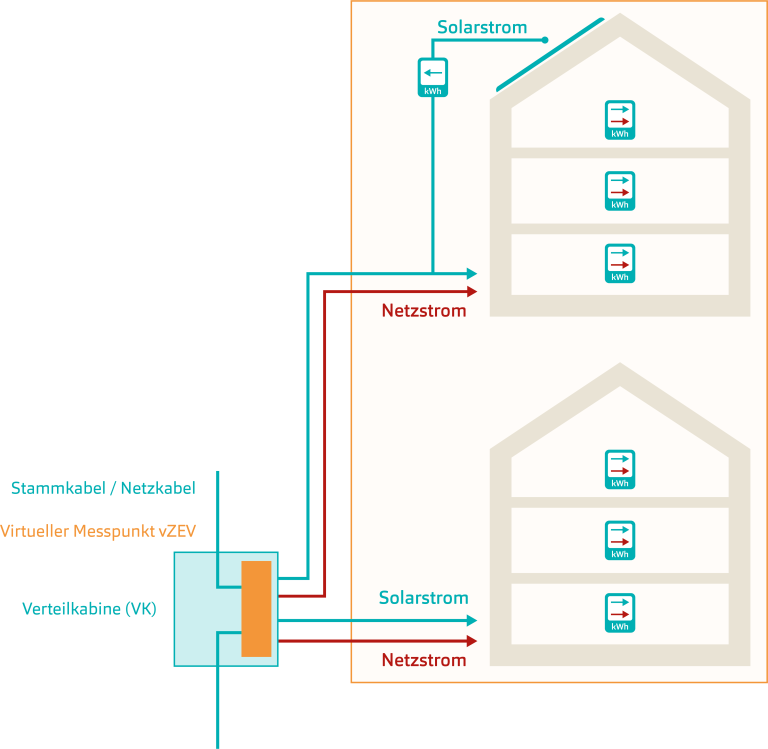
Multiple electricity consumers can form a joint consumer group and share the electricity produced on-site. Unlike a ZEV, a vZEV allows for the creation of virtual metering loops and, under certain conditions, the use of parts of the public grid to connect with other properties (shared connection point). Only IBC-certified smart meters are permitted in a vZEV.
For information on possible groupings, please visit: (vZEV Check – Check the requirements for your virtual ZEV)
Requirements for forming a vZEV:
Multiple property owners join together and appoint a representative who acts as the vZEV’s external representative.
The production capacity of the systems must be at least 10% of the vZEV’s grid connection capacity.
All vZEV participants are located behind a common connection point (distribution cabinet, junction box network). A vZEV is considered a single end customer by the distribution network operator.
An application must be submitted to the local distribution network operator (IBC) at least 3 months before the vZEV begins.
All necessary services can optionally be obtained from the IBC under the ZEV/vZEV billing service.
Local Electricity Communities (LEG) make it possible to use and sell locally produced renewable energy directly within a community. End consumers, renewable electricity producers, and storage facility operators can join together to form a LEG and exchange electricity among themselves. The public grid may be used for this local electricity trading, and reduced grid usage rates apply provided that the legal requirements are met. For information on potential partnerships, please visit: (LEGhub – Your platform for local electricity communities (LEG) in Switzerland)
Requirements for forming a LEG:
A partnership of end consumers, renewable energy producers, and storage operators, managed by a LEG representative.
All participants must be connected to the same local power grid. (Grid level 5 or 7, and the same substation within the same municipal area)
The production capacity of the facilities must amount to at least 5% of all grid connection capacities.
An application to form a LEG must be submitted via the LEGhub platform at least 3 months before the LEG begins.
LEG participants are located behind a virtual connection point and remain IBC customers. IBC currently only bills for the regulatory supply from the grid. The internal energy exchange within the LEG must be organized independently by the LEG representative.
Responsibilities of the Representative
ZEV/vZEV:
As of the date of commissioning, the ZEV/vZEV self-consumption community is considered a single customer by IBC. The property owners are responsible for all matters concerning the ZEV/vZEV, in particular for appointing a representative. The representative is the sole point of contact for IBC regarding all matters related to the ZEV/vZEV, particularly with regard to contractual agreements concerning connection to the distribution network or consumption from the grid.
The representative is specifically responsible for:
LEG:
From the date of commissioning, the participants in the LEG remain individual customers of the IBC. They are grouped together behind a virtual connection point. The IBC bills only the regulatory supply from the public grid directly to the individual participants. The LEG representative is the sole point of contact for the IBC regarding all matters related to the electricity community and the local energy exchange. The local energy exchange within the LEG is organized and managed not by IBC, but by the representative.
The representative is specifically responsible for:
The representative of the respective self-consumption solution determines the billing model and serves as the sole point of contact for IBC.
The representative is responsible for billing and metering within the ZEV. IBC makes the metering data available via the customer portal. If necessary, a billing service provider can be engaged. IBC offers a billing service.
Virtual ZEVs can only be operated using IBC smart meters. The representative is responsible for billing within the vZEV. IBC makes the meter data available via the customer portal. If necessary, a billing service provider can be engaged. IBC offers a billing service provided that the vZEV is located within IBC’s distribution network.
LEG participants are located behind a virtual connection point and remain customers of IBC. IBC currently bills only for the supply from the grid as defined by regulations. Energy exchanges within the LEG must be organized independently by the representative.
For more information about locally produced electricity, visit lokalerstrom.ch